

Why are we, in the West, so uncomfortable with death?
Last year Dee and I took a short break in Portugal. It was outside of tourist season, so it was easy to relax. In this Atlantic coastal area, there was plenty to do and see. One day we hiked along the cliffs, as the sun lit up the golden rocky outcrops as far as the eye could see. It felt like we were ascending to the heavens. The next day we took a trip down some old salt mines. 230 metres underground. Not a whisper of the wind, not the smallest ray of natural light. Only darkness, caverns, stillness. Polar opposite experiences, but both fascinating in their own way.
Another day we walked through the local national park. Everywhere we looked the flowers bent slightly from bees hopping from one beautiful specimen to another. A close inspection of the ground opened up a whole new world under our feet as ants and other insects built their homes or gathered food. We paused for a while in a bird hide, set on the edge of a pond amidst a copse of native trees. The pond teemed with life from the inside out, as water birds and fish shared their space without jealousy. Meanwhile, the branches of the trees were bent low, as birds of every size, shape and colour populated them so much that it was easier to see feathers than leaves. As we walked on and the sun started to dip in the sky, a flock of flamingos glided over our heads. Life swarmed us at every glance of the eyes.
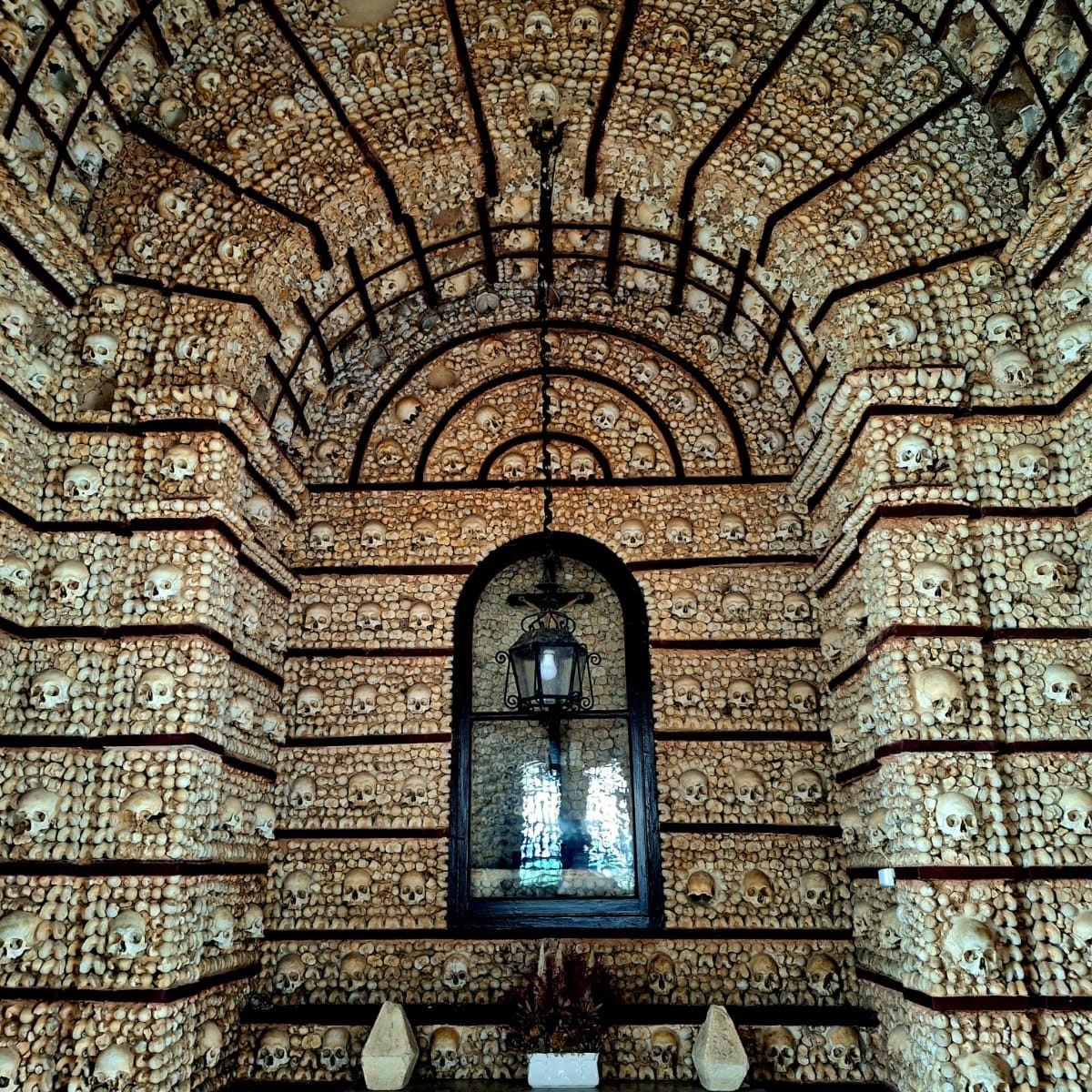
But a polar opposite stood out from this experience too. On our final day we visited one of many ossuaries in the area. A chapel made from the bones of the ancient churchgoers and ministers in the local town. (See picture above)
The site is a novelty that tourists love. While Dee (a doctor), amused herself by identifying the various kinds of bones, I started to mull over how stark a contrast this place was to our teeming nature park. I hoped that some tourists, looking for interesting photos ops, would stop and consider what surrounded them. I also stopped to ponder why we have no problem considering the glory of God in the living world, (or for the Atheist, considering the marvels of life), and yet seem to have a fear of contemplating death. It seems that those priests of a past age had no such qualms about thinking upon their mortality. Consider this poem from one of these ossuaries in the region:
“Where are you going in such a hurry, traveler?
Pause…do not advance your travel.
You have no greater concern than this one:
That which is now before your eyes.
Recall how many have passed from this world,
Reflect on your similar end.
There is good reason to do so;
If only all did the same.
Ponder, you so influenced by fate,
Among the many concerns of the world,
So little do you reflect on death.
If by chance you glance at this place,
Stop … for the sake of your journey,
The longer you pause, the further on your journey you will be.”
In the West, in this era, there is accessible healthcare, child mortality rates are low, and we tend to live longer. One would imagine that such an environment would foster a healthier acceptance of death even among atheistic societies; a sort of, “well we have lived long and well and will die old and full of days… compared to a lot of the world”. And yet living better for longer doesn’t translate into this acceptance. Instead we try to bury it deeper. We use euphemisms for death, we make it a taboo subject to talk about, we delay making wills, etc. Death has no role in our life. Instead, we find people are “Through fear of death… subject to lifelong slavery”, as the author to the Hebrews puts it. And sadly, this remains the case for many Christians too.
What if instead of fearing death, as slaves to it, we made it subject to us? What if we allowed it to teach us and push us to act in the right direction. It is a Biblical attitude after all:
“For all our days pass away under your wrath; we bring our years to an end like a sigh.
The years of our life are seventy, or even by reason of strength eighty;
yet their span is but toil and trouble; they are soon gone, and we fly away.
Who considers the power of your anger, and your wrath according to the fear of you?So teach us to number our days that we may get a heart of wisdom.”
– Psalm 90:10-12
Where I live now in South Asia, death is everywhere. From murals of people being shot in the head during rebellions, to the national flag’s deep red, representative of blood, from animals heads hanging up in the bazar where you watch your dinner being butchered, to people who are near death begging on street corners… no one is trying to hide it. Our packaged meat Western view of the world doesn’t exist here. Death is not hidden behind closed doors.
It was the same once upon a time back home too though. Having a tour through a medieval graveyard in Perth, Scotland, gave a glimpse at the same reality from generations ago. In a time where plagues abounded and child mortality was so high that children were only called by a number until they reached a certain age and received a name, death was an ever present reality. Of all times, one would think that people would try to shut it out in those scenarios, but no.
Walking around that graveyard was eye-opening. Grave after grave was marked with images depicting lessons from death, and inscribed upon most of the gravestones: Memento mori – “Remember death”. In other words, let it be your companion, and your guide. The dead did not want people to ignore it while they lived. Some other graves had: Disce Mori – “Learn how to die”. The living need this teacher. On the way out, as we bowed through a low archway, we passed beneath a final image. An image seen only by those who had the good fortune to enter into the graveyard, and then exit it again…
A skull, an egg timer, a sundial, and again the words Memento Mori. A call to remembrance that your time is limited, death is near, do not forget it while you live.
For those who have victory in Christ’s resurrection, we of all people should not fear death. And this is certainly not intended to make us do so. Its sting is gone. But that doesn’t mean we just ignore it either. Rather we should tame it, bridle it, allowing its yet abiding presence to teach us and prepare us for life unending.
That’s not to say that it isn’t an enemy. It is. But it is a defeated enemy. An enemy that is not yet destroyed, but is held captive by the One is alive forevermore and who holds the keys of death and hades. What if we were to treat it as the captive it is? To see death as one that is now under the rule of another, and can therefore be used in his service to teach us?
How would this change our outlook on life? How would it change prayer meetings where our common tendency is to pray away our problems, rather than lean into them? How would it change what we invest our time in? Maybe instead of ignoring the inevitable, running from it, hiding the sundial under a bushel, we allow it to teach us what it means to truly live.
It might just also change our outlook on how we view sacrifice as I’ve written about before: (here, here, and here). How would people invest in the mission of God in their local communities and abroad, if a healthy pause and consideration of the brevity of life formed a little part of their day? We need not become morbid nor depressed, nor am I suggesting we obsess over it, but I imagine most of us (certainly those of us who hail from the West), could do with a healthy dose of genuinely praying through Psalm 90 and taking time each day to bridle death and allow it to lead us into living life to the full. We have been delivered from the fear of death, let us therefore number our days so we may gain a heart of wisdom.

 Imitators of Those
Leave a Reply