

Recently I was visiting a poor rickshaw driver’s family in their home. Our teammates have befriended this rickshaw driver, and treated him well, witnessing to him in word and deed.
They live in a field behind a large mosque, with a handful of other small one-room dwellings. Their entire living space is about 7ft by 7ft. They crammed us four adults and two children onto their bed made of pallets while they sat on the floor, offering us incredibly generous helpings of questionable food. They gave out of their poverty with such glad smiles on their faces.
As soon as we had vacated their house (not a moment too soon, as the pallets began to crack under one of my companions rear-end), we stood and chatted in the small courtyard outside. The surrounding apartment blocks towered over this little dwelling, reminding them of the temporary nature of their existence. With the rate at which new buildings are erected here, it likely won’t be long until they are forced out to make way for something larger to be built on the land. Yet, while they are there, they enjoy it, and we looked around, practicing naming the different fruit trees that stood around the buildings, asking questions as to why there was a sandal tied to a branch on the mango tree, and engaging in general chit-chat.
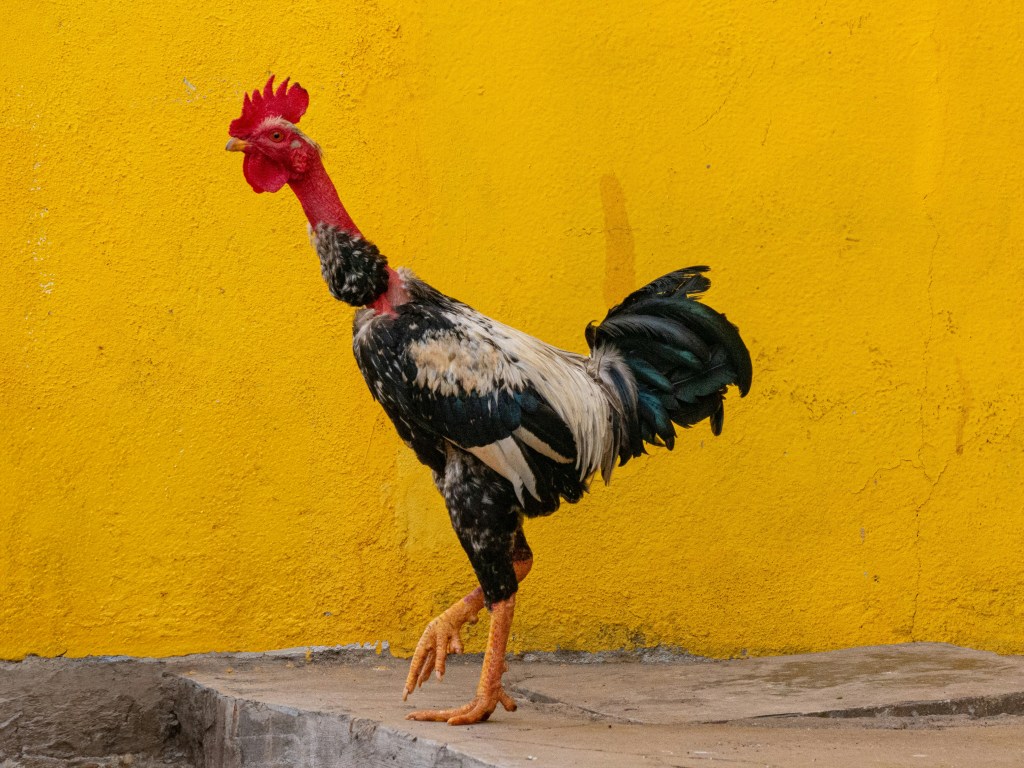
Then we noticed a scrawny chicken strutting about the courtyard. A chicken with a string tied around its leg. Curious, we asked our host about it.
“Well,” he explained, “the chicken is tied to a tree for so long, that when it is released, as long as it has the string on its ankle (do chickens have ankles?) it thinks it cannot go any further than the length of the original string. It is still attached in its own mind.”
I had heard only a few weeks previous to this, that the same is true of elephants in Thailand, where elephant tourism is a huge industry. No one can control a fully-grown elephant. So, the trick is to shackle the elephant to a tree when it is a baby. It pulls and pulls, trying to escape, until it resigns itself to the fact that it is stuck. It is conditioned to associate the shackle with an inability to roam freely. Years later, a shackle that is not tied to anything, will keep the elephant in line, as it supposes that it cannot break free of the one who is guiding it, even though, physically, it is completely capable of doing so.
The releasing of these animals gives the illusion of freedom. They look like they should go free, but as long as the shackle remains, they are stuck in the hopelessness of captivity.
It reminds me of the condemnation that Jesus brings on sign-seekers:
“When the unclean spirit has gone out of a person, it passes through waterless places seeking rest, but finds none. Then it says, ‘I will return to my house from which I came.’ And when it comes, it finds the house empty, swept, and put in order. Then it goes and brings with it seven other spirits more evil than itself, and they enter and dwell there, and the last state of that person is worse than the first. So also will it be with this evil generation.”
– Matthew 12:43-45
Here, Jesus points to the same problem that holds the chicken and the elephant in its clutches, that is, the illusion of freedom. A person can be “freed” from an unclean spirit, but there’s a problem. They’re not really free at all. In fact, the freedom they seemed to have gained is soon made worse by the fact that the unclean spirit returns with its friends.
This illusion of freedom is all around us. In every attempt to flee from one system of slavery, we find ourselves in the grip of just another form of hopelessness. The tether to the master we served may be gone, but the shackle remains. And there is no amount of space we can be given that will undo that conditioning. As long as the shackles remain, we are paralysed. We can be left in an open field, with abundant opportunity for freedom. And yet we remain slaves.
I felt this keenly yesterday, Easter Sunday. In the morning, I rose and reminded myself of Christ’s resurrection. My heart leapt as I listened to some music proclaiming the living King. After a while I went with my family to join our new church family, singing, praising, praying, and hearing of the one who conquered death. It is the ultimate proclamation of freedom; Christ overcoming the grave! We proclaimed joy and hope to one another, in the knowledge that resurrection life exists, despite the difficulties we face. It was precious.
Some of my English students had accepted my invitation and joined us for their first experience of Easter. After the service they invited me to their home, and to an art exhibition that their friend had created. Happy to return the acceptance of invitations, and spend more time with this seeking couple, I went.
However, when I arrived at the art exhibition, I was struck by the greatest possible contrast that I could have found on Resurrection Day. The exhibition explored the artist’s struggle with his diagnosis of infertility. In a culture that shames those without children, and where it is assumed to be the woman’s fault, it was impressive to see a man publicly bare his feelings about the pain and shame of being the cause of childlessness.
But as I walked around the exhibition, I was struck by the hopelessness of it all. The artist told me that expressing himself through this art project was part of the healing process. I nodded along, as I often feel the same way. For me it isn’t visual art, it’s the art of language. Writing, poetry, song lyrics. In deep gratitude I often bow my head with Andrew Peterson and declare:
“To all the poets I have known…
You walking wounded of my life,
Who bled compassion in the heat of strife,
You stood between my heart and Satan’s knife,
With just the armor of a song.
Thank God for poets I have known”
It is true that the arts can be a place of healing, of saving our hearts in the darkest places. So, I immediately empathised with him. But as I surveyed the project, I soon felt a huge difference.
I saw photos sent by one person who, in her barrenness, turned to worship Krishna, feeding and caring for her clay idol in place of a baby. Another letter came from a woman in Australia, who had taken to making African fertility dolls in the hope that she might conceive. Letter after letter spoke to how this project had helped people feel seen, and yet, each letter ended with the despair of hopelessness.
My response to the poets, and that of these people were actually radically different. Not because art has more power over one than another, but because the only art that can really help, is that which contains hope. Sometimes this hope only exists in germ form as words and emotions give way to cries to the one who can actually do something about it. But regardless, these songs in the night meet us in the darkness and take us by the hand, leading us to the light, however slow it may be.
My new acquaintance spoke of one prison, that of shame and sorrow over his diagnosis, and intimated that his art had helped him process that. But as I pressed him on what it had accomplished in his heart 5 years on from when he began, he could still only speak to the same hopelessness. Only now it was encapsulated in art form. He had given shape to his hopelessness, but it remained hopelessness still. With confidence he spoke of how art had in a sense freed him, and yet, like the chicken and the elephant, he still carried the shackle. The illusion of freedom was evident in every painting, photograph and clay piece.
So, what is the solution? We don’t merely need a new environment with the same old shackles. Shackles in a prison and shackles in an open field have the same effect it seems. What we need are broken shackles.
People are doomed to leap from one environment to another, without addressing the shackles that bind them wherever they go. The new environment may look like freedom, but it is all an illusion. It still ends with the same hopelessness as before. Or, as Jesus taught, often seven times worse. Only when the Holy Spirit comes in, bringing new life, breaking our shackles and infusing us with real hope, can we find real freedom. Something external needs to enter in and fill the void.
It’s the Easter message of not merely the acknowledging of an issue, but the conquering of it. It is the breaking of the shackles that exist in this life. It is awaiting Pentecost, where there is something new poured into people, and rather than white-washing dead men’s tombs, it calls those dead men out of tombs to resurrection life.
We’re not so different to chickens and elephants. But thank God we have Easter, where our shackles were broken for good.

 Imitators of Those
Leave a Reply to The Longings of the Human Heart – Imitators of Those Cancel reply