

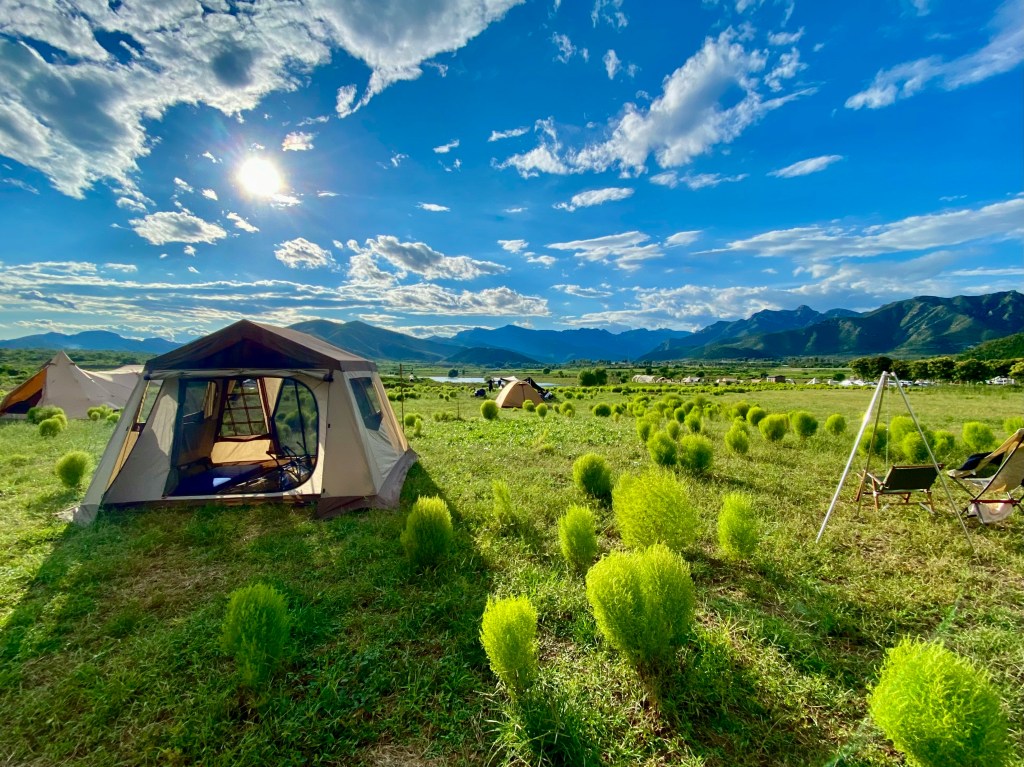
Childhood summers meant camping. On an almost rolling two-year cycle, we would one year go down to camp in the very south of Ireland, and the next, load up our 7-seater car with all manner of things, catch a ferry to England for a quick visit with our grandparents, and then take the Channel Tunnel to France. We’d drive across Europe for a couple of weeks, spending a few days at one campsite, then hauling everything back into the car and moving on to another, to explore a new area.
We had a big 8-man tent, that stood proud over the normal-sized tents scattered across those European campsites. We could usually spot it from a distance away and navigate our way through the maze of tents to it with ease. Due to its large domed sections, we dubbed it the Taj Mahal.
Somehow, this yearly pilgrimage seemed well-fitted to my family. When my parents separated and sold the house they had built, they had achieved something that neither of their families had managed for at least four generations on my father’s side, and probably something similar on my mother’s. They had stayed in one place for 25 years.
In stories that remain for another time, early last year I started some family research on my father’s side. As I interviewed my father, and read back through historical documents in musty archives, I discovered that my impulse to travel and have restless feet was perhaps not incidental, as the houses, areas, and countries on the list of the last 4 generations grew and grew as I traced their paths through life. I come from a family of nomads. The area in which I grew up never had members of our family there before we arrived, and it is unlikely that it ever will again. Our roots were shallow.
Compare this to my wife’s family. They have been on the same farm for as long back as anyone can remember. They are descendants of French Huguenots, and along with some other families in the area, it is highly likely that they arrived sometime in the 17th century, fleeing persecution in France. Their roots run deep. And, unsurprisingly for a farming family with such deep roots and attachment to the land, they have travelled very little outside their area.
Dee and I are planning to write some complimentary blogs soon, on the differences in calling in mission, and how these two upbringings surely played a part in that (both for better and for worse in both cases, it must be said), but this week I’ve been yet again struck by how important the need for a “tent-inhabiting” mindset is.
Leviticus is centred around a tent. Not just any tent, but the tent in which the Almighty God, whom the heavens cannot contain, condescended to dwell in – the tabernacle. He was a pilgrim amongst the pilgrims, and desired to be their God and they his people. So the book deals with how one can approach this tent, how one can live in proximity to this tent without being consumed, and ultimately has in view a settling in the land, a permanent residence, where God’s presence would yet remain.
But as Leviticus approaches its end, having dealt with the above, there is an interesting section on the feasts that the Lord commanded to be celebrated, even once they were settled in the land. The purpose of these feasts? Primarily to remember. To remember that none of this came about by their own doing. One of these feasts is the Feast of Booths.
The people would one day enter the land. They would finally “sign the lease” on their deeds, put their feet up on their second-hand Canaanite stool, and breathe a sigh of relief. They were here. Now, time to put down roots, forget those troublesome years, and create a community to last for years to come, providing for your children, and your children’s children.
But this wasn’t the goal that God set for them. He knew the dangers of too much rootedness. He knew it would firstly lead them to be susceptible to imbibing too much of the Canaanite culture, hence why they needed trained eyes of discernment. But he also knew the danger that excessive rootedness brings; memory loss.
Living in tents in the wilderness was evidence of a two-fold reality. One, they had been brought out of the house of bondage by the Lord’s great salvation. And two, they were not yet home. Sitting in a comfy chair in Hebron might seem like the goal, but it wasn’t. Moses knew that. Hence why he insisted that there was no point in them going into the Land if the Lord would not go with them. The goal was his presence, not simply a rooted life. And that comfy armchair, with a glass of fresh milk, and honey dripping off some freshly baked bread, may seem pleasurable, but it certainly wouldn’t foster a recalling to mind of where they had come from, or remind them that the goal was an eternal kingdom with God’s presence. And it would be even easier for the next generation, who had not faced those days, to be disconnected from those two realities: They had been redeemed by a mighty salvation, and there was an ultimate goal to be fulfilled.
So the Lord made them dwell in tents once a year. So that:
“… your generations may know that I made the people of Israel dwell in booths when I brought them out of the land of Egypt: I am the LORD your God.”
– Leviticus 23:43
Recently we’ve been doing a lot of travelling in-country. In the past three months we’ve been to the South, the North, and the East of the country, and in a few days, we are heading to the Westernmost areas. Some of this travelling has really tired us out, and the constant moving hasn’t helped the first-term-missionary feeling of rootedlessness. In fact, we were so tired after the last trip, that we almost cancelled our upcoming one.
On top of that, we are already needing to have discussions about where we will move to once we finish our 2 years of language study in the capital. On the move again, to put down some shallow roots in yet another city.
And as these pressures have faced us, it was this Feast of Booths that came to mind. Being on the move, feeling a lack of roots, is not a bad thing. God desired that the people feel that in a small measure on a yearly basis, so that they would not lose perspective on what lay behind and on what lay ahead. To recall to their minds where they had come from, and at what cost they were brought out, and about the hope that the Lord had promised to them.
It’s so easy to lose that perspective ourselves. To get so comfortable, (or even to seek to be so comfortable) that we easily forget the salvation behind and the hope ahead. The more rooted we are, the more fixed in time our minds become. Wendell Berry’s novel, Jayber Crow begins with describing the town of Port William in this way: “It had a beginning that it had forgotten, and would have an end that it did not yet know. It seemed to have been there forever.”
This is a truth that many of us feel in our lives as individuals too. Caught in between the complicated natures of what was, and unsure of really where the path ahead is leading us to (what will be), in terms of life plans etc., we just are. We exist, and often just have to get on with life as it presents to us in the moment. And yet, for the Christian there is more. We are called to remember what was. Never to forget our roots, when we were born again to a living hope. Nor are we to lose sight of the hope set ahead of us, neither despairing over what’s around us, nor fixing our hopes on the temporal. Our calling is to regularly (in the case of the Feast of Booths, yearly), be formed by distinct patterns of remembrance. The Lord’s Supper itself calls us to the same reality. “Do this in remembrance of me… For as often as you eat this bread and drink this cup, you proclaim the Lord’s death until he comes.”
Remember. His death. Until he comes.
As I prepared to write this, I recalled to mind that I had already written about the advantage of having my kids grow up as nomads. Possibly my favourite piece I’ve written. And yet, it was written less than a year ago. Again, I wrote only a few months ago, on the calling of Christians as a migrating people. And here I am writing again. Why? Because I need the constant reminder. That’s the purpose of the whole thing. I easily forget, so the Lord, through his Word, repeatedly brings it to mind. A regular pattern of being a nomad reminds the soul of the salvation that was and the hope that will be. And then hopefully we will live in the present with that high calling of holiness that much of Leviticus calls us to.
And lest the point has not yet been sufficiently reinforced, even as the prophet Zechariah looked forward to the glorious day of the LORD, he would finish out his book with a vision of eternal worship to the King, the LORD of Hosts. What does that worship look like? People from all the families of the earth keeping the Feast of Booths. It will be an eternal feast. There will never be a time in which we will not have need to recall to mind the pilgrim journey that brought us to the golden shores. May we do what we can to foster that mindset now, and engrain it into our families, that the generations may know, that our God has lead us on this way.

 Imitators of Those
Leave a Reply to Teleported to Glory – Imitators of Those Cancel reply