

There is an Irish TV show which was (and I believe still is) aired yearly when we were growing up. Its name was Reeling in the Years, and each episode would contain footage from both international and Irish events from one year in history, over which would be set some music from that time. In this simplistic format, even children could observe and begin to understand something of the events that have defined our world and our nation in the past century.
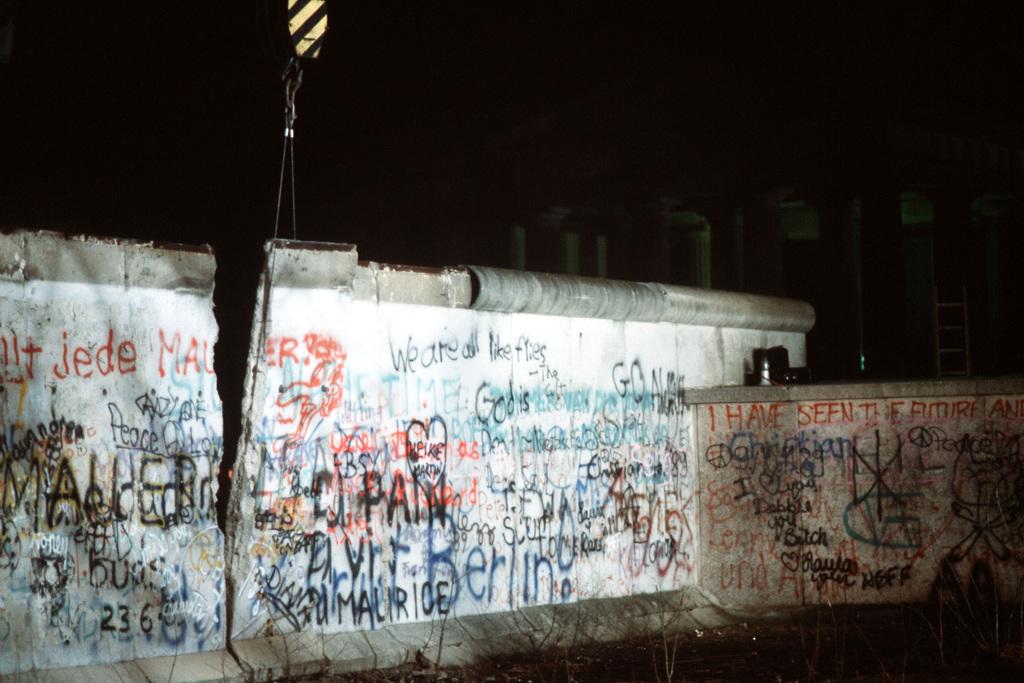
One such world-defining imprint upon my mind from the 1989 episode are the images of many Germans climbing upon the Berlin Wall, shouting victory cries, celebrating, and with sledgehammer and chisel tearing down the dividing wall that had plagued their city for so long.
Reading in Acts and 1 Corinthians recently has been a reminder of how the early church also had to tear down their own dividing walls. Rather than shouts of victory, it was with suspicion, sometimes hypocrisy, and much messiness that they approached the task. The dividing wall of Jew and Gentile was as ugly as the graffiti-covered concrete slabs of Berlin. But the tools of its downfall would not be made by human hands, but with understanding the timeless purposes of God, the love of Christ, and the unity of the Spirit.
What pain must have entered the heart of God when ethnic lines separated his children or prevented the gospel from expanding to the ends of the earth. But what joy must have come when something so foreign to the world sprung up, as churches muddled through the murky waters, and learned to love one another. What greater display to the world that they were Christ’s disciples than that they “love one another”, when previously they were enemies. When Gentiles embraced the God of Abraham, revealed in Christ, and when Jews laid down their rights to embrace their new siblings in the faith.
It seems that spanning nations and the ages, this is a common experience. Every society has its divisions, cutting across ethnic, religious or economic lines. In Northern Ireland it is the divide between Protestant and Catholic, and a reluctance for the former to reach across to the latter. In our area of South Asia, it is the divide between Hindus and Muslims, between believers from a traditional background and those from a Muslim background. And this is the struggle for believers from both sides in this present time.
But the incomprehensible beauty of the gospel is that it does indeed tear down those walls. It is the power of God to save both Jew and Greek, but also at work in them to unite them into one body, to the glory and praise of Christ.
One such story from our church in South Asia stands out in this regard. Beauty* is a girl from a tribal village area. Her tribe are spread out across two countries, and are about 50% Christian, though a lot of that is very nominal. This is a very common story for those among Tribal or even some Hindu communities in our country. The gospel went out and changed many of these minority communities, but unfortunately, in a lot of cases, they have moved from true gospel growth into nominalism.
Beauty grew up in this nominal Christian setting, but as a true believer. However, as part of a minority community in a majority Muslim country that can oppress such minorities, she shared with her peers an abiding resentment towards Muslims. Even as she moved to the city to be the first from her tribe to earn a university degree, she held onto this hatred for Muslims. As a Christian, she viewed them as lesser, and not even worthy of receiving the gospel.
But as she started to encounter other believers, living out their faith in intentional ways, her heart began to change. As she learned more of the Word of God, she began to see the love that he has for the world, and even for her Muslim neighbours. She started attending a church where she was able to learn about the differences in language they use, about what they believe, and about how to reach them with the gospel. And with a heart changed by the love of Christ, she started evangelising others all around her with a deep joy in her heart.
One day, Beauty and another lady from the church were out trying to start conversations with women, but there were only men to be found. Wisely, they stopped and prayed for just one girl to be able to talk to. A few minutes later they came across Hope*, who had anything but hope. She had grown up in a conservative Muslim family but had seen the damage that such religion can do. She knew nothing except that Islam was false, and that she wanted more. Now, a reluctant Atheist, she had searched in Hinduism, and Buddhism for the hope that she needed, but had come up empty. Depressed, she sat down in the park, in her darkness longing for some light.
Beauty and the missionary with her engaged Hope in conversation, and after praying for her asked if she would like to study the Scriptures with them. Over the next few weeks they started going through John’s gospel, and by the time they got to chapter 4, with tears in her eyes, Hope embraced Christ.
Several months later, we stood by the edge of a river, as Hope spoke of how she had been “without hope in this world”, but now fulfilled her name. Beauty and one of the elders stood either side of her and plunged her into the waters as testimony to her new life.
Personally, I love baptisms. I love seeing the hope of new life exhibited in this physical way. But what was even more beautiful that day was the witness to the power of the gospel to transform in multifaceted ways. Not just to save a Muslim girl, but to use the ministry of a former Muslim-despiser to do it. That baptism was testimony to how the gospel had broken through two hearts, and brought them together in Christ.
20 “I do not ask for these only, but also for those who will believe in me through their word, 21 that they may all be one, just as you, Father, are in me, and I in you, that they also may be in us, so that the world may believe that you have sent me. 22 The glory that you have given me I have given to them, that they may be one even as we are one, 23 I in them and you in me, that they may become perfectly one, so that the world may know that you sent me and loved them even as you loved me.
– John 17: 20-23
*Names changed for security


Leave a Reply